Operations & Workflow
How clear workflows keep projects on track
Defined steps and ownership turn execution into predictable progress
Date
Olivia Harris
Sophia Bennett
Client Success Manager
Clear workflows create predictable progress
A well-defined workflow gives every project a clear path forward. Instead of relying on constant coordination, teams follow a structured sequence of steps that guide execution from start to finish. Each stage is understood, and progress becomes easier to track.
This structure reduces uncertainty. Teams don’t need to guess what comes next or how tasks connect. With a clear workflow in place, projects move forward with consistency and direction.
Defined steps reduce friction in execution
When workflows are clearly outlined, tasks are easier to manage and complete. Each step has a purpose, and transitions between stages are smooth. This removes unnecessary back-and-forth and keeps work moving efficiently.
Teams spend less time clarifying process and more time executing. By reducing friction, workflows enable faster progress without sacrificing quality or alignment.
Ownership keeps everything moving
Clear workflows assign responsibility at every stage. Each task has an owner, and each stage has defined accountability. This eliminates confusion and ensures that nothing is left unattended.
When ownership is visible, delays are easier to identify and resolve. Teams can quickly see where progress is slowing and take action, keeping the project on track.
Structured systems scale with confidence
As projects grow in complexity, workflows provide the stability needed to maintain performance. What works for one project can be applied consistently across many, without losing clarity or control.
With structured systems, teams can handle more work without sacrificing organization. Projects remain aligned, progress stays visible, and outcomes become more predictable over time.
Clear workflows create predictable progress
A well-defined workflow gives every project a clear path forward. Instead of relying on constant coordination, teams follow a structured sequence of steps that guide execution from start to finish. Each stage is understood, and progress becomes easier to track.
This structure reduces uncertainty. Teams don’t need to guess what comes next or how tasks connect. With a clear workflow in place, projects move forward with consistency and direction.
Defined steps reduce friction in execution
When workflows are clearly outlined, tasks are easier to manage and complete. Each step has a purpose, and transitions between stages are smooth. This removes unnecessary back-and-forth and keeps work moving efficiently.
Teams spend less time clarifying process and more time executing. By reducing friction, workflows enable faster progress without sacrificing quality or alignment.
Ownership keeps everything moving
Clear workflows assign responsibility at every stage. Each task has an owner, and each stage has defined accountability. This eliminates confusion and ensures that nothing is left unattended.
When ownership is visible, delays are easier to identify and resolve. Teams can quickly see where progress is slowing and take action, keeping the project on track.
Structured systems scale with confidence
As projects grow in complexity, workflows provide the stability needed to maintain performance. What works for one project can be applied consistently across many, without losing clarity or control.
With structured systems, teams can handle more work without sacrificing organization. Projects remain aligned, progress stays visible, and outcomes become more predictable over time.
More Articles
How systems create scalable and consistent operations
Olivia Harris
How transparent payments improve cash flow clarity
Olivia Harris
How visibility builds client trust in every project
Sophia Bennett

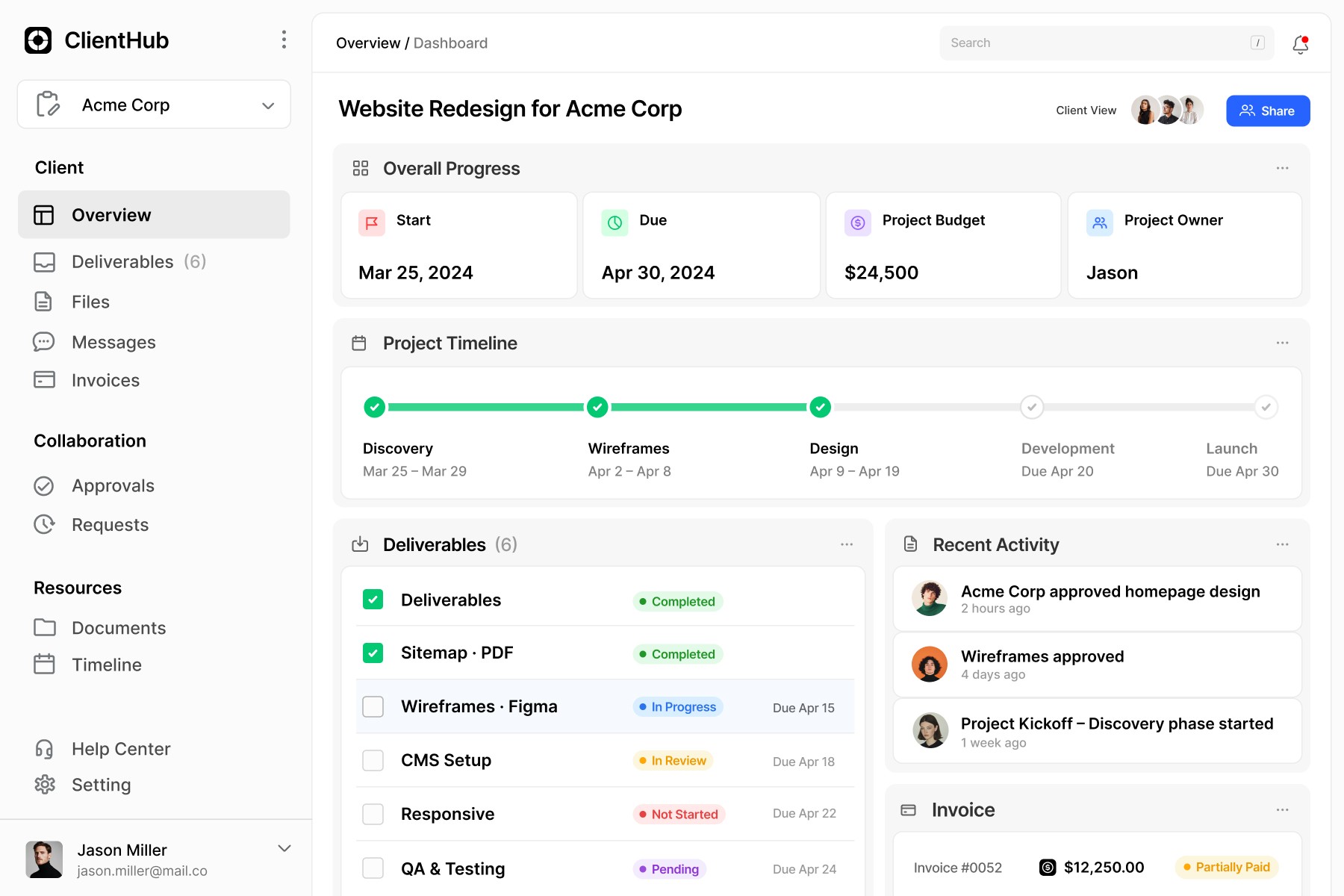
Bring clarity to every client interaction
Manage projects, approvals, and payments in one structured system

Bring clarity to every client interaction
Manage projects, approvals, and payments in one structured system
Bring clarity to every client interaction
Manage projects, approvals, and payments in one structured system